Double cloth decisions

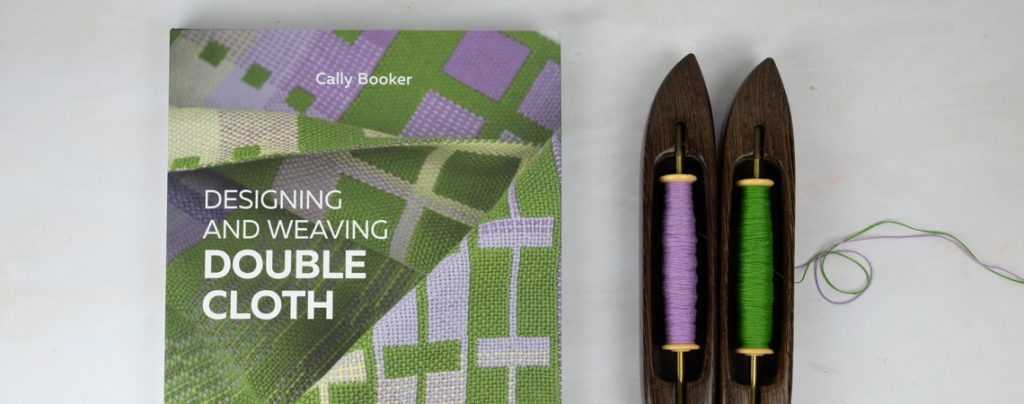
I’ve been thinking about writing a new series of Warp Space posts/emails for subscribers to my Weaving Space website. Of course, it has to be about double cloth: given my book project, I don’t think anyone would be surprised that this is the topic spilling out of me at the moment.

And as I thought about what I might share, I found myself going back over in my mind all sorts of decisions that I had to make in the writing of it, because there is not one right way to ‘do double cloth’ but all sorts of options and possibilities. Options and possibilities are great! But they can also be paralysing, and in order to get to the loom we have to cut through them and whittle them down to “I am going to do this in this way”.

In the book, I have presented different ways of achieving the same thing, and have tried to do this in a way which (i) balances breadth with depth and (ii) offers context for those choices. Take, for instance, the most basic element of a weave structure: how should we thread the loom?
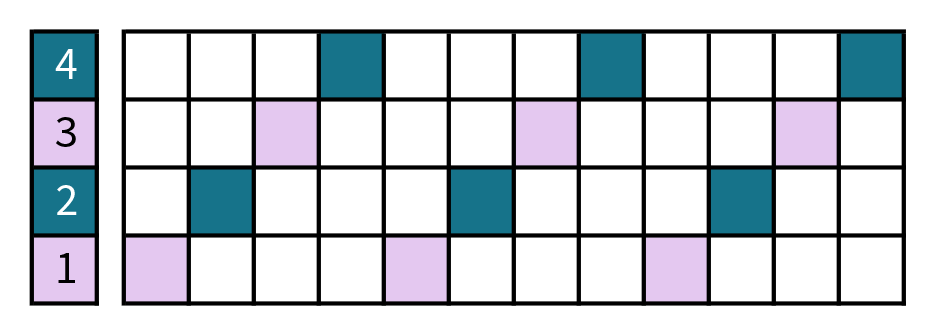
A straight threading for double weave on four shafts
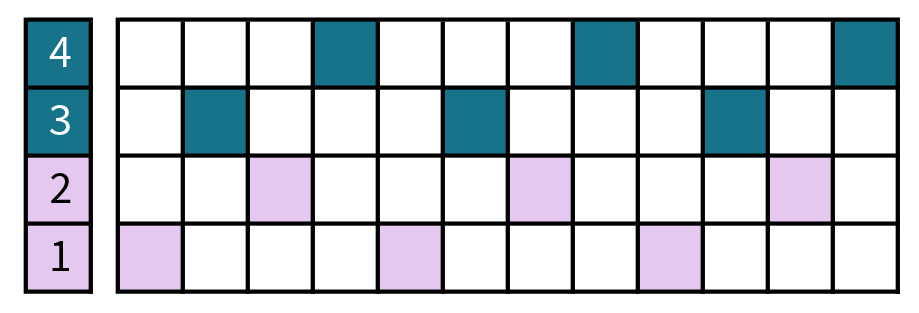
A divided parallel threading for double weave on four shafts

There are many possible ways to thread the loom for a double cloth, but this decision often comes down to a choice between the straight threading and the divided parallel threading shown above. Does it matter which you use? And in what sense might it matter? Does it just affect the process or does it affect the outcome as well? What are the circumstances that might me lead me to one choice or the other?

These are all questions I have attempted to address within the book, but they are also questions where I have a lot more thoughts than would fit within its pages! So I thought it might be fun to lift the lid on a few decisions: both the decisions we might make as weavers, and the decisions I made as a writer when highlighting those weaving decisions. 

Does that sound like over-thinking to you? Welcome to the tangled world inside my head!

Finding a focus

I plan to address the thorny threading question as part of the series, but as I began to write I found myself reflecting on the book as a whole. This is a little bit self-indulgent of me, because it doesn’t concern the practicalities of weaving, so I felt these ruminations might be better posted on my personal blog where self-indulgent rumination has a well-established home!

There’s so much that goes into a woven piece. Obviously, there is the yarn and the weave structure; there are the techniques and processes we use both on and off the loom; there is the detail of the draft; the sett and the sleying pattern. Stepping back a bit, there is the inspiration for the piece, which will lead us to certain colour and fibre choices; and there is the context for the piece, its role and function, both within our own creative practice and in the wider world. This might include our level of experience, our personal style, whether the piece is intended to have a specific function and what that function is… I could go on and on.

Having undertaken to write a book about double cloth, I had only narrowed down one of these elements – the weave structure – and that not by much! So how to take all this and make it manageable within the confines of a book? I made a couple of key decisions, based purely on my own interests and preferences.

There are two main reasons, it seems to me, why double cloth is so magical. One is that it gives us the ability to create three dimensional structures in a single piece. The other is that it allows us to see two distinctly different layers of cloth side by side. I decided to make the second reason my main focus. I have included some drafts and examples for three dimensional structures as well – I could hardly talk about double cloth without going some way down this path – but my focus is on the ways in which we can manage the exchange of layers in order to make patterns. Because I am a greedy weaver. I want a lot from my loom, and the thing I am most greedy for is pattern.
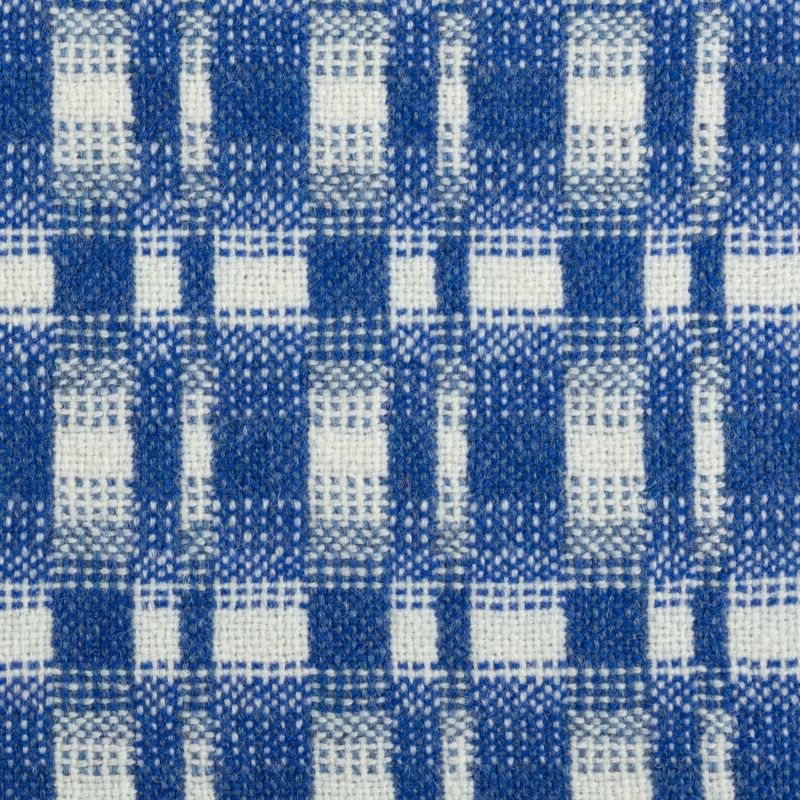
And once I had decided that pattern would be my focus, I knew exactly how I wanted to organise the book: in chapters themed around different elements of double cloth pattern-making. It’s an aspect of design that sits somewhere between the vision we have for the piece and the detail of the weave structure, and I decided I wanted to sit in the middle and try to draw those two things together. I wanted to offer each element as a broadening of our double cloth repertoire, and to build up a set of tools we can use to put these elements to work.

  • The first chapter lays the foundation: working with plain weave layers. 
  • Then in chapters two, three and four we add the visual design elements of blocks, diagonals and curves (I’ll come back to these when I talk about threading). 
  • Chapter five takes a side step to talk about colour, and this is the only chapter with a project in black and white! Another decision to come back to, perhaps. 
  • Chapters six and seven focus on alternatives to plain weave: huck in chapter six, twill in chapter seven.
  • And then in the last two chapters we get down to the practicalities and another kind of decision-making: how do we get these two warp layers onto the loom, for instance?

A word about projects

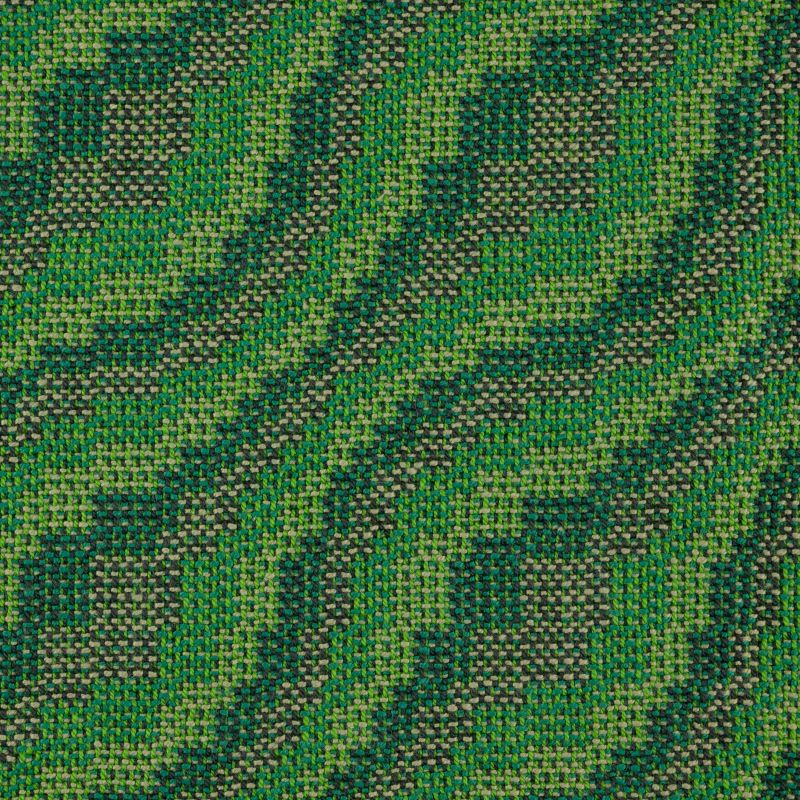
I mentioned the project in chapter five. This book does have projects in it, but it is not intended to be a project book. This was in fact the first decision I made, before I even signed the contract. I explained to my publisher that I wanted to write a book of principles and processes, and that if they wanted a book of projects then I was the wrong person. But I did want to show those principles and processes in action and the projects I have included are intended to do that. Here’s a design based on diagonals: this is what inspired me, and this is how I’ve expressed that inspiration in weave. 

And it was fun! I pretty much suspected that I would not absolutely love the process of writing a book, but what’s not to love about designing and weaving projects? Isn’t that why we’re here??

That’s enough of my self-indulgence! Or is it? If you are interested in my behind-the-scenes ruminations on what projects to make and include, let me know.
Double Cloth Decisions was posted by Cally on 4 May 2026 at https://callybooker.co.uk
I wrote a book

Many times over the last few years people have asked me if I am going to write a book. And for the last three years I have answered that “I am writing a book”. Now, all at once, I am someone who has written a book, and that book is real!

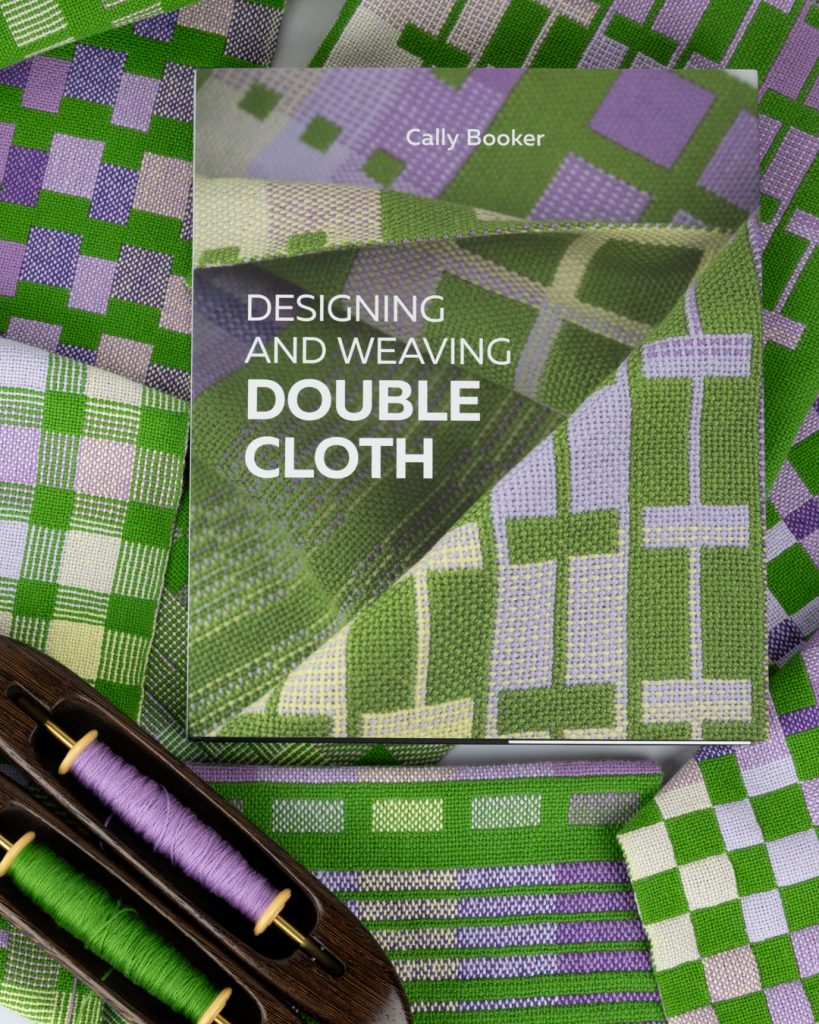
It won’t be published until the end of this month (the UK publication date is expected to be 24 March), but last week my advance copy arrived and I can finally see and touch the result of hundreds of hours of work. Thank goodness, I can honestly say that I love it. The publisher, the designer, the printer have all done a wonderful job and the finished product is better than I could have imagined.

Why yes, I did make a nest for my book out of the sampler that appears on the cover. Wouldn’t you?

I am equal parts excited and nervous to share this book with the world. Excited, because hey, three years’ work and a lovely hardback book! Nervous, because it feels very exposing. Not just of my writing, drafting and diagram-drawing (though I’m conscious that there are always mistakes which are undetectable until they are in print, and then suddenly become blindingly obvious), but exposing of myself, of my thoughts, of the way that I think. At least, of the way I think about weaving and weave structure, which are the things I am thinking about most of the time!

I’d better not follow that particular train of thought any further, or my equal parts may tilt into too much nervousness. I’ll just add that you can find out more about the book itself at doubleclothbook.com where I have shared some sneak peeks at the content. There are a few extras to come too, for those who purchase a copy!

I wrote a book was posted by Cally on 2 March 2026 at https://callybooker.co.uk
Reflecting on 2025

This has been quite the year, hasn’t it? I started 2025 with a January trip to California, where my father lives, and when I look back at that trip now I feel as though I am peering at it through the wrong end of a telescope. Is that really me?

Reflecting on making

I’ve enjoyed every minute I have spent at the loom this year, but there simply haven’t been enough such minutes. Most of my scarce weaving time has been spent sampling, experimenting, exploring, which I absolutely love. So I am trying not to feel too disappointed that I don’t have any significant new work to show for it, because that will come. But it does sting a bit, no getting away from that.

The new work I have completed has been at the computer, where I have spent hundreds of hours over the last two years. Those hours have delivered one finished manuscript, over five hundred captioned images, four rounds of proofing and now, at last, one forthcoming book Designing and Weaving Double Cloth. It’s been intense! I am grateful to have got this far (there were many, many moments of doubt) and am looking forward to sharing more about it as publication day approaches.

There are two things about this experience which stand out for me. One is that I could not have done it alone, and I am immensely thankful for everyone who has helped me bring this project to its conclusion. That includes people who cheered me on, people who gave me feedback, people who lent me their skills, people who taught me new skills, and many more.

And that brings me to the other notable thing, which is that I have particularly enjoyed extending my skills in areas I had never previously thought about. Writing doesn’t scare me, but vector illustration certainly did! And now I am turning out diagrams and mocking up page layouts as if Adobe Illustrator were my second home. It’s never going to be my strongest suit, but it’s been a pleasant surprise to find that I am holding any cards at all.

Reflecting on changes

I’ve already blogged about the big move, so I don’t have much to add here. The possibility had been bubbling in the back of my mind for the last couple of years, but until I had submitted the book manuscript to the publisher, I didn’t have enough space in my head to turn the idea over and look at it from all sides. I must say that it feels seriously good to reach the end of this year with both of these giant tasks accomplished.

There’s an aspect of this year which I haven’t yet shared beyond family and friends, because it feels rather the wrong size and shape in the context of everything else in the world. But our feline companions have often featured in this blog over the years, so I think I should bring things up to date.

We started 2025 with three lovely cats: our senior cat, Polly (aged seventeen or eighteen), and ‘the kittens’, Pippi and Magnus (who actually turned nine last year). We end the year with none.

Pippi had a lymphoma and died in January. Polly was overtaken by old age and kidney failure and died in April. Magnus had very complex health issues, which he had been an absolute trooper about for over a year, but took a sudden downturn and died in August. We knew that these things were coming, but to have them come so thick and fast has been brutal. We miss them dreadfully.

Reflecting on inspiration

This year has been a peculiar one for inspiration. On the one hand, I have been so intensely absorbed in the things immediately in front of me – three sick cats and one demanding manuscript – that I feel I have hardly raised my head to look around me. On the other, the book project has brought me into places where I am spending a lot more time with writers than I have done before, and it’s been fascinating to get that glimpse of another creative process.

Here are a few things I’ve been reading, which could be loosely grouped under the theme of inspiration:

  • The Subtle Maneuvers newsletter by Mason Currey
  • Doom and Bloom by Campbell Walker
  • What Art Does by Brian Eno and Bette A.
  • Oliver Burkeman’s newsletter The Imperfectionist

The energy I’ve met in writerly humans is positively buzzing, and in stark contrast to all the bland drivel being generated by AI, and I love that. I’ve always enjoyed words and reading – and remain defiantly human both in my self-expression and my use of dashes – but I am now very clear in my own mind that while writing is part of my work, writing is not my work.

Reflecting on teaching

One of the things that most reliably inspires me is teaching, because I love spending time with other weavers. And I learn so much!

In the first place, turning a topic into a workshop is a fantastic way to clarify my own thinking about it. It forces me to slow down, to articulate what I know, to unpick what I don’t know, to do more research and experimentation, to identify the underlying principles, to find analogies, to discover how to communicate it all. It’s such a rewarding process.

And then I get to surround myself with weavers, all bringing their own expertise into the class, and I learn even more, both from their weaving experience and from their response to the workshop. It’s learning all the way down! Honestly, I couldn’t ask for a better job. If you’ve been part of a workshop in 2025, know that weaving with you has been one of the highlights of my year.

So that’s 2025, or almost. As for 2026, I am going into it with the expectation of spending a great deal less time at the vet and the intention to spend a great deal more time at the loom. How about you?

Reflecting on 2025 was posted by Cally on 18 December 2025 at https://callybooker.co.uk
Moving on

13 years ago, in the summer of 2012, I moved my looms into a top floor studio in Meadow Mill.

A photo of Meadow Mill against a blue sky

I’m old enough now that, in many ways, 13 years doesn’t feel to me like a particularly long time. We’ve lived in the same house for twice as long as that; been married for nearly three times (!) as long. But these particular 13 years have held a great deal of change, both for me personally and in the wider world, and the shape of my life and practice now is very different from the shape of my life and practice then.

And it is time to move on. Much as I have loved my Meadow Mill studios – and I’ve occupied three different studios over those years – the space is no longer the support to my work that it once was.

Since the pandemic, a series of eye-watering rent increases have made me look more sternly at my budget and ask hard questions about what I really need. To teach online, for instance, what I need is not a big space, but a fast and reliable internet service. My studio was great at the former, but my home is a whole lot better at the latter. So it’s been on my mind for a while that I should seriously weigh up my options, but while I was working on the manuscript for my book I couldn’t find any space in my head for Big Thoughts About The Future. Now that the publication process is underway (more on that soon!) and I have had a few months to ponder, I found my concerns basically came down to two main themes: the stuff and the people.

The stuff is quite an easy theme to address in principle, although time consuming in practice. Over the last three months I have done a LOT of pruning. Looms have been sold and given away, yarn and books have been donated, and a great deal of paperwork has been archived or shredded. We’ve carried out a similar exercise at home to make space here: shelves have been emptied, furniture carried off by the recyclers, and so on. There are a few weaving items which I don’t want to part with, but can’t currently accommodate: a small storage locker is taking care of those for now.

The people theme is a little bit more scary. When I was a new entrant into the creative industries, it was very isolating to work at home alone, and I didn’t like it at all. Moving into the studio meant I joined a community of other artists and makers, where I could learn, participate, collaborate and discover new opportunities that otherwise I would never have known about. There’s a part of me that is very nervous about giving that up.

But, as I said earlier, a lot has happened in these years. On the one hand, I have been extremely fortunate in the networks of connection I have been able to plug myself into within the city, across Scotland, with weavers around the world. On the other hand – in large part thanks to those rent increases – much of the community I valued in the building has already broken up and moved elsewhere. So if the question is people, Meadow Mill is not necessarily the answer.

I think the challenge to me here is to be intentional about how I use my time both inside and outside the studio, so that I am continuing to foster connection and not simply retreating into my weaving cave. Mind you, with exhibition deadlines coming up, a bit of intensive loom time might well be in order. What was that I was saying about balance?

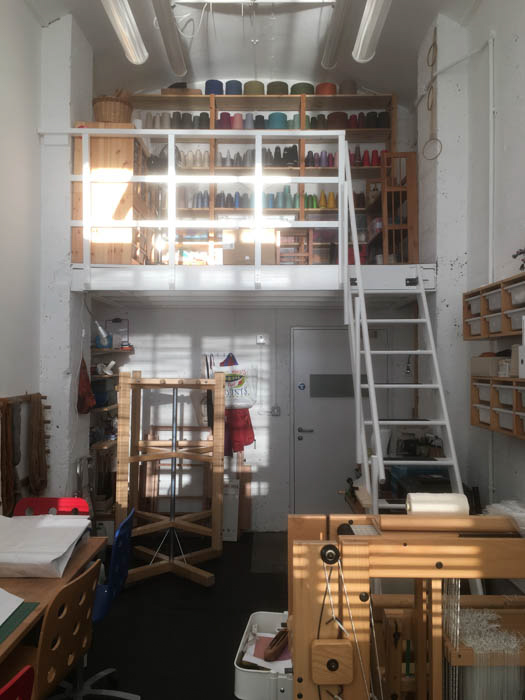
A photo of looms in a bright room with large windows
Not very cave-like, I admit.

Moving on was posted by Cally on 20 November 2025 at https://callybooker.co.uk
What does balance look like?

Back in March of this year I was invited to speak to a group of creative and entrepreneurial women about the evolution of my weaving business, and to answer their questions about some of the decisions that I have made. They asked great questions! It really got me thinking about the winding road that I am travelling on, and sparked far more thoughts than I could share at the time, so I thought I’d put some of my musings here on my blog.

I posted some thoughts on starting out in my business here. This second post is my reflections on the eternal question…

How do you balance running a business with developing your own creative practice?

If there is anyone who finds it easy to do this, I have yet to meet them. For most people this is a continual work-in-progress, and inevitably so because nothing is ever stationary for long.

I know that I have been in the place of thinking “aha, I have this all worked out now, and I have a lovely balance in my life between these diverse interests and pursuits” and five minutes, five days, five months later something in the environment shifts and changes (oh hello, pandemic, fancy meeting you here) and I have had to shift and change in response. And if there’s ever a moment when the universe isn’t changing around me, then it’ll be me doing the changing, as my interests evolve and develop. So my perspective on this is that balance is never achieved, there is only the act of balancing.

Balance is never achieved, there is only the act of balancing.

As it happens this is something I have been giving a lot of thought to lately. For the last two and half years I have been working on a big project which has (i) sucked up most of my time and attention, and (ii) given me a way of working that has been fairly stable. It’s been a very creative project, but it has also been a very outward-directed one, and I think this is an important point. Because running a business can in fact be a very creative experience, and I have learned to enjoy all sorts of things that I never imagined could be enjoyable. No, I’m not yet a passionate enthusiast for the filing of tax returns (an area of business where creativity is perhaps regarded less positively). But thinking of ways to present information on my website, streamlining the booking process for workshops, working out how to get yarn and dye information onto labels: these can be quite niggly things, but there is also scope for learning, for fun and for experimentation there.

So a really important aspect of the balancing act is expanding my ideas of what creative work looks like. It turns out that those three things I mentioned — learning, fun, experimentation — are key elements that help to make work feel creative and energising for me. But it is also the case that the majority of work in running a business is focused on the experiences of others: the experience of people who visit my website, who join a workshop, who purchase something from me. It matters enormously to me that I make those experiences as good as I possibly can, and so my antennae are always tuned to the response that I get to my latest experiments.

Making icons, presenting course material, arranging cakes for contextual photos… All part of the job.

However, I also need space and time just to listen to myself and to explore my own ideas. This is the aspect of creative practice that is perhaps most difficult to incorporate into running a business and yet, for an artist or a maker, it is also the most essential. My intention, not always achieved, has been that 20 per cent of the time I spend working should be spent on my own creative work. And, now that my all-consuming project is moving into a new phase, I’d like to increase that proportion to 40 per cent.

Because, ultimately, my own ideas are basically all there is here. If I don’t have those to offer, then what is the point?

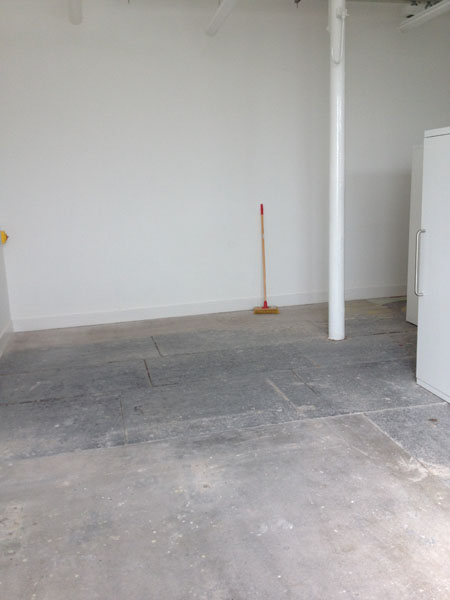
When I think about this, the story that always pops into my mind is one told by Grayson Perry when he gave the Reith lectures. His series was entitled Playing to the Gallery and you can still find it on BBC iPlayer or buy it as an audiobook. There’s a section towards the end of the final lecture where he describes the work that goes into putting on an exhibition, and he conjures it up very vividly. He describes the empty white room at a big museum which he has to fill with work, for everyone to look at, and for the press to review and comment on. And this work has to sell, because his income, and potentially the income of several other people, depends on it. But on top of all of that, he notes, there is the expectation that he will go into his studio and create this work “with the carefree joy of a child”. The audience laughs, as well they might, because it sounds like a recipe for insanity.

And yet, and yet… that is basically the act of balancing we are all trying to pull off in life, isn’t it, whatever we work at? Perhaps the question is less about time constraints and more about the fear that I sometimes hear people express, that “if I had to do it, it wouldn’t be fun any more.” I think that might be a topic for another post.

What does balance look like? was posted by Cally on 12 June 2025 at https://callybooker.co.uk

1 2 3 4 60