Firth of Tay – notes and thoughts

Firth_of_Tay

I promised that I would post a round-up of the various components of this design. They have all appeared in this blog, but scattered over more than a year – a fairly realistic illustration of my scattered thought processes.

The overall design is a very personal one, incorporating three different ideas.

One is the use of statistical data as a source of pattern, specifically the Scottish Index of Multiple Deprivation which I described here. I have used the SIMD data to derive miniature portraits of various towns and villages. Well, I think of them as portraits, though in practice they are basically bar charts. Each block in the finished piece is a woven bar chart roughly 5″ long which portrays one place.

The second idea comes from old maps: the linear kind, such as maps for pilgrims, which show the desired journey as a more-or-less straight line and which highlight places to rest, stay overnight etc. I wanted to weave a linear map which would be autobiographical, highlighting places which have been important to me since I came to live in this area more than 20 years ago. So I sat down and made a list of 20 years’ worth of place-connections to be woven in chronological order.

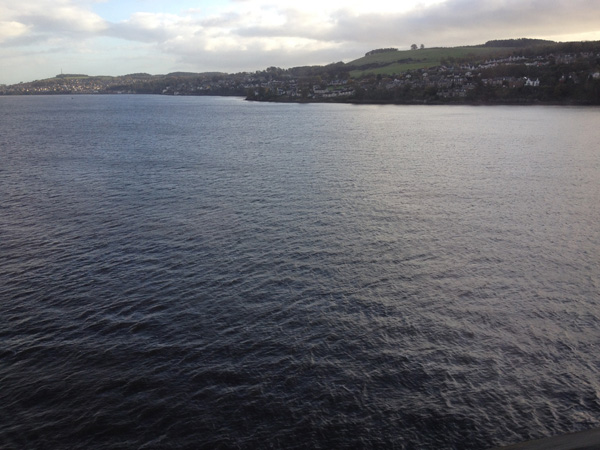
The final component is the river. The line that links together all my places – indeed, the whole region – is the Tay. I decided to focus on the tidal stretch of the river, even though some of my places lie further upstream. This was mainly because it is the Firth of Tay I see every day. Its moods and rhythms are the moods and rhythms of daily life in Dundee. The Tay estuary is mainly shallow and the surface of the water is very lively: lots of small choppy waves all bumping into one another. This is why I chopped up the blocks into segements where the colours are reversed.

That’s a brief summary of the motivation; now a brief summary of the practical side.

I have 16 shafts at my disposal and I wanted to use double weave with 8 shafts for each layer and a gradual layer exchange (switching one pair of shafts at a time). My sampling began with this warp threaded for an advancing twill on 8 shafts in each layer – but with a completely different plan in mind. I loved some of the effects but this is the wrong idea for them: they need to be developed with an idea of their own.

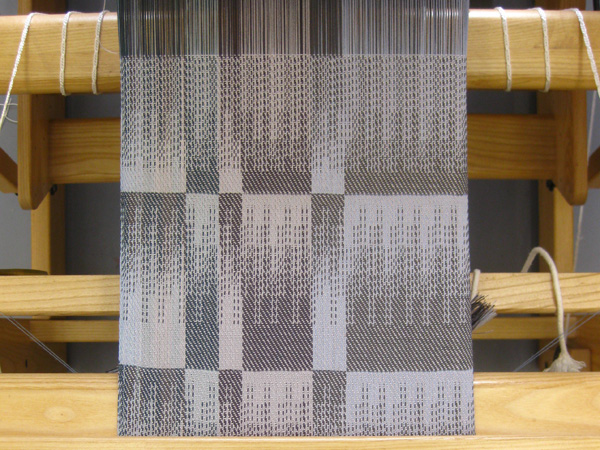
The next sample warp had a simple straight draw threading, which was a bit dull but allowed me to try the liftplan I’d previously worked out and see how it scaled to my proposed weight of warp yarn: two strands of 60/2 silk per end. I found that even though the layer changes are frequent, the fabric was still quite slippery and it benefited from the introduction of a stitch here and there. (I referred to the excellent article by Doramay Keasbey in The Magic of Doubleweave to work out what I needed.)

Being happy with the weight of yarn, I then sampled for colour. The Tay is famously silvery, of course, but I found that the silver-coloured silk on its own was a bit too pink: OK for some highlights, but I wanted more blue. The threading I used here is the one I settled on. It’s a more rapid advance than the one in the first warp so the blockiness is less pronounced, but it’s still choppier than the second version.

I tried a whole host of wefts on the last sample warp and liked them all, so a final choice was very difficult. I wanted to have a single unifying weft not lots more choppiness, and settled on a mid-value grey bourette silk which gives the finished fabric a satisfyingly rough texture.

The last step was to test the whole plan with a mock-up in Excel. I couldn’t model this in Fiberworks without spending hours copying and pasting specific units of the liftplan. (My chain needed to be 72 lags, eight for each of nine possible layer combinations, and the maximum Fiberworks tie-up is for 64 treadles.) But it is amazing what a lookup function combined with conditional formatting can do.
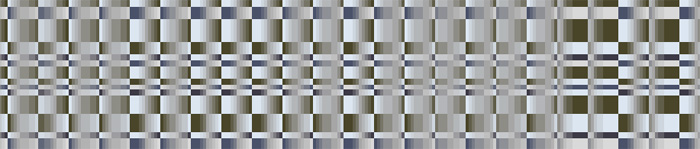
yardage mockup sideways

The ‘extreme’ blocks at the right-hand end of the chart represent one particular place which has quite a skewed SIMD profile. I wasn’t sure whether it was too extreme for the rest, but decided to stick to the plan anyway. In fact, I like the extremes in the finished piece, maybe even more than the middling places, though it did make it difficult to take a ‘representative’ photo.
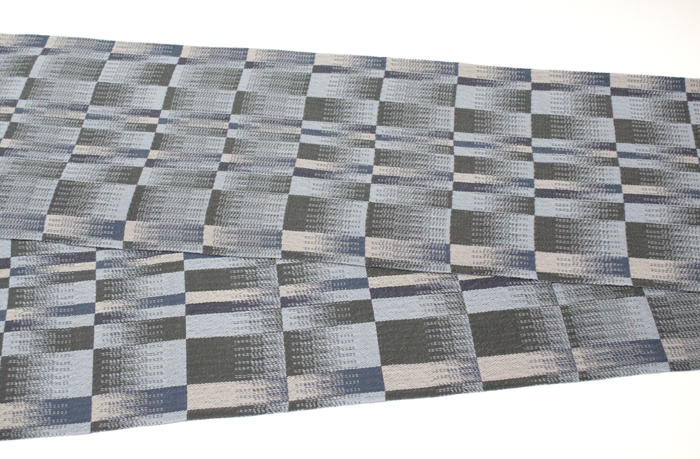
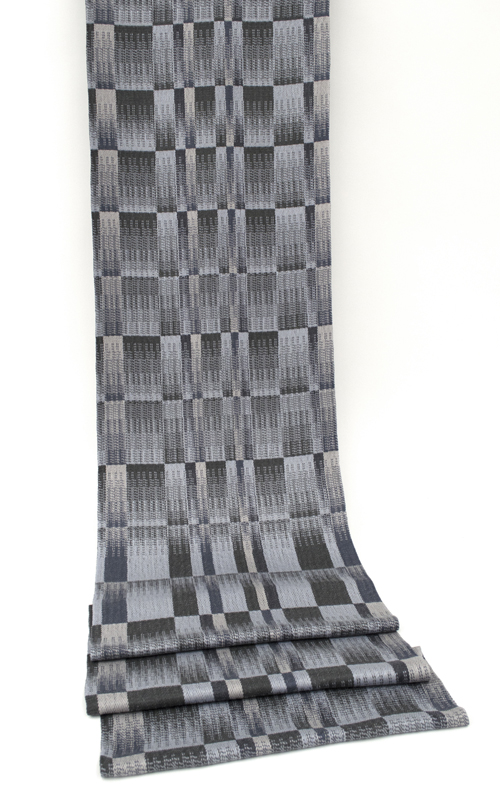
Firth of Tay sideways

Firth of Tay – notes and thoughts” was posted by Cally on 8 Feb 2014 at http://callybooker.co.uk

Creative Commons License

Finished and photographed

Well, I am still tunnelling through the marking mountain, fuelled chiefly by caffeine and carbohydrates. I wouldn’t say the end is in sight yet, but I am nearer the end than the beginning. Or, possibly, going round in circles. But we did take a couple of hours at the weekend to hang up the double cloth yardage and take some pictures.

It proved to be more challenging than we really wanted given the time constraints… The total length is 3.6m, but we couldn’t capture more than a couple of metres at a time which limits the amount of variation which is visible.

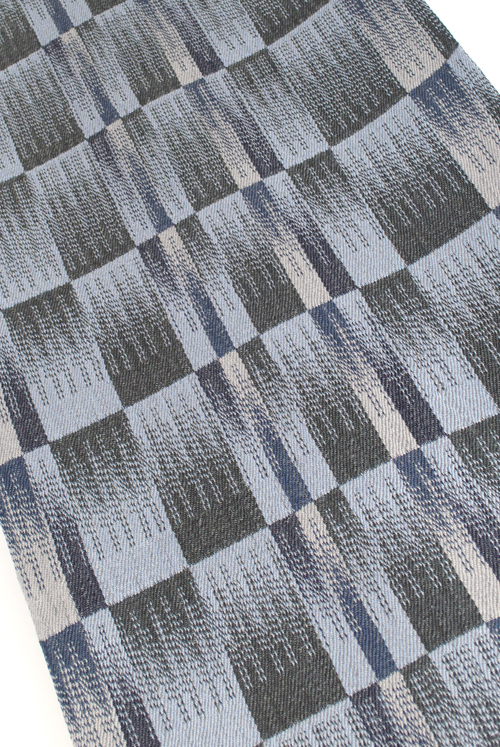
The best angle for maximum viewing length is on the diagonal, thus:

Firth of Tay diagonal

Although we also quite liked the pleated-excess-on-the-floor look:

Firth_of_Tay

You can see more of the pattern (or get more of a hint of it, anyway) by folding the cloth back on itself and getting two lengths for the price of one:

Firth of Tay sideways

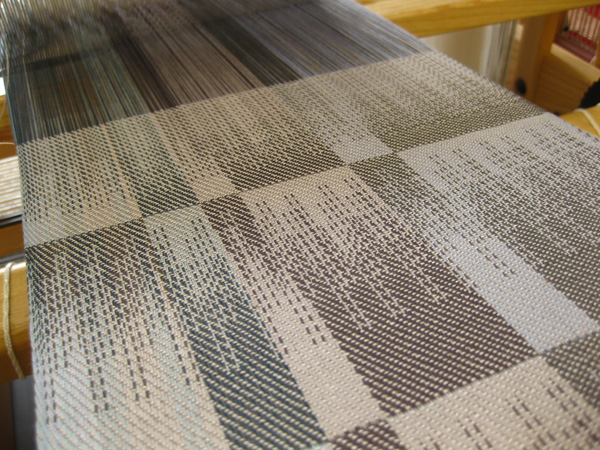
I’m really happy with the overall look, which is very much as I had imagined. I hadn’t imagined the texture close-up, though, and had rather a happy surprise. Did I mention I settled on a mid-grey bourette silk for the weft? It’s a rough textured singles yarn and the finished result is very lively. I’m not sure whether this close-up is close enough to show the wiggles in the twill… but I can assure you they’re there.

Firth of Tay detail

I’ve called it simply Firth of Tay. I need to get something else on the loom sharpish: don’t like it empty, no matter how much marking there is to do.

Finished and photographed” was posted by Cally on 27 Jan 2014 at http://callybooker.co.uk

Creative Commons License

Layers and Linear maps

Exactly as I had imagined them! Only better because they are not just figments of my imagination.

Here are my grey (and blue and turquoise) silk layers exchanging:

grey silk map sample 2

Each warpwise block is about 5 inches long and is essentially a stacked bar chart — although I prefer to think of it as a ‘statistical portrait’ — representing a place somewhere along the Tay. By putting together lots of these blocks I am aiming to build up a linear map of life along the river. Except that I’m not planning to be comprehensive but autobiographical, so the places I am choosing are those which have been important to me over the 20+ years I have lived in this area. And, if it is especially important or of recurring importance, the same place may appear several times.

Well, that’s the plan. I still have to choose the final colours, but the design is making me very happy. Here it is from above.

grey silk map sample

It is intended to be seen from a distance, so — in case you don’t have room to back away from your screen — here’s a thumbnail.

grey silk map sample

And if all this grey in your feed reader is making you wonder where the real Cally is hiding, do pop over to see my newly refurbished website, where there is plenty of colour and more to come soon. I don’t think I have broken too much, although there are a few things I am still tweaking. It’s all about the tweaking.

Layers and Linear maps” was posted by Cally on 7 Jan 2014 at http://callybooker.co.uk

Creative Commons License

some inspiration

I had a chance to visit Edinburgh today and managed to get to the Peter Doig exhibition just a few days before it closes.

Wow.

I can’t remember whether I have ever seen a show which had so much background material — sketches, photographs, studies — accompanying the major works, and it was fascinating to see so many different perspectives on each theme. I will never look at a pink umbrella in the same way again. If you can’t get to Edinburgh by Sunday, then you can either catch it at the Musée des beaux-arts in Montréal next year or see some highlights online.

On another inspirational note, a few weeks ago I attended the Craft Scotland conference where the keynote speaker was Hans Stofer. His talk also gave us a glimpse into his working processes and we were all left buzzing with excitement. (I wanted to run straight out of the room and make stuff, which wasn’t the ideal response at the beginning of two days of lectures, but there you go.) Craft Scotland have just posted an extract from Professor Stofer’s talk here. Read and enjoy.

I love crossing the bridge by train. Especially when the light on the water is uncertain. Fortunately, our weather makes sure that it often is.

October light

some inspiration” was posted by Cally on 31 October 2013 at http://callybooker.co.uk

Creative Commons License

orange, lilac and green

Thanks to everyone who visited last weekend”s Open Studios. Those who came towards the end of day two may have found me a bit incoherent as I’m not accustomed to so much talking. It was all good fun, though, and I was delighted to see so many kids (of all ages!) having a go at weaving on a table loom. One wee girl in particular really took to the loom. I showed her a 1/3 twill first, so she just had to lift one shaft at a time, then she overheard me telling her older brother about lifting two shafts at a time and she worked out the 2/2 twill progression all by herself!

In loom news: I was able to finish weaving with the lilac weft and had a nice fat wodge of cloth on the loom.

keeping track of yardage

(In case you were wondering, the white threads are marking off metres.) However, I decided to cut it off…

cut off

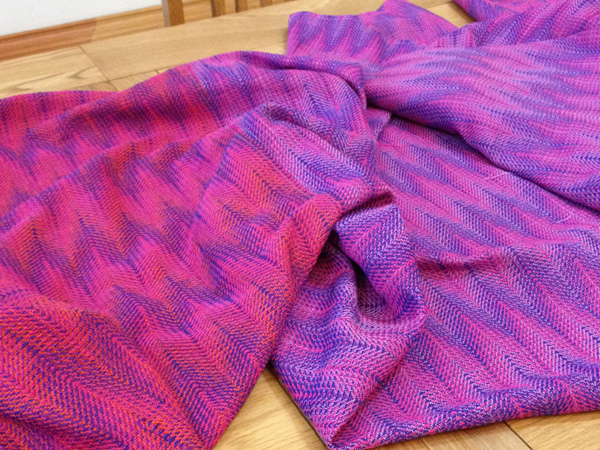
blue-pink yardage

…and re-tie before starting to weave the last stretch of the warp in green.

blue-pink with green weft

And the really good news of the week: we have our new washing machine! I was able to wash the yardage yesterday, and have a lot of pressing ahead.

orange, lilac and green” was posted by Cally on 26 October 2013 at http://callybooker.co.uk

Creative Commons License

1 48 49 50 51 52 53 54 60